
Federal Judge Sets July 24 deadline for US Attorney’s Office in Cleveland to Respond to Challenge of Restitution Collection Practices in Mortgage Fraud Cases
Federal Judge Sets July 24 deadline for US Attorney’s Office in Cleveland to Respond to Challenge of Restitution Collection Practices in Mortgage Fraud Cases
FOR IMMEDIATE RELEASE
CLEVELAND, OHIO – July 6, 2026 – FreeTonyViola.com announced today that U.S. District Court Judge Donald C. Nugent issued an order in United States v. Anthony Viola, directing the government to file a substantive response to a motion challenging the government's collection of restitution. Previously, prosecutors sought to have the motion denied on procedural grounds and failed to respond to the claim that they were illegally seizing assets, but the Court found the motion warrants consideration on its merits and ordered a substantive response.
Millions of dollars in court-ordered restitution have been collected in cases prosecuted by both federal and state prosecutors through a multi-jurisdictional Mortgage Fraud Task Force. However, none of the funds being collected have forwarded to victims, who themselves say they did not sustain a loss, did not request restitution and have not received any funds.
Attorney Kim Corral’s Challenge to Government Collection Practices
Attorney Kim Corral identified multiple issues concerning restitution orders, including amendments to orders years after a final judgment, different restitution amounts in the same cases for defendants who pled guilty to the same charges, the lack of any accounting mechanism for cases when the same mortgages are involved in separate proceedings and improper collection methods by seizing assets from American citizens. Ms. Corral filed a motion on behalf of Mr. Viola arguing that the government’s collection of restitution has been improper. Prosecutors attempted to have the motion dismissed but, rather than dismissing the motion, Judge Nugent ordered the government to file a new response addressing the legal merits by July 24, 2026, with a reply from Mr. Viola due on August 7, 2026.
The Court has not ruled on whether the government's actions were lawful. However, Judge Nugent's recent order requires the government to explain its legal authority and respond to the merits of the challenge. This order represents the first time in years that these restitution collection issues will receive substantive judicial review.
Ongoing Allegations of Grant Fraud and the Misappropriation of Crime Victim Funds by Federal and State Prosecutors in Ohio
The restitution dispute also revives longstanding questions about the Cuyahoga County Mortgage Fraud Task Force itself, which received funding from the U.S. Department of Justice, Bureau of Justice Assistance (BJA) through Grant No. 2009-SC-B9-0080. According to grant documents, the funding was awarded to increase the capacity of the Cuyahoga County Prosecutor's Office to investigate and prosecute mortgage fraud by expanding the Task Force and hiring additional personnel. Grant materials and correspondence submitted to the Department of Justice reported that the Task Force prosecuted hundreds of defendants and obtained more than $15.27 million in restitution and forfeiture orders arising from mortgage fraud prosecutions.
What is the Government doing with Restitution Collected on Behalf of Crime Victims?
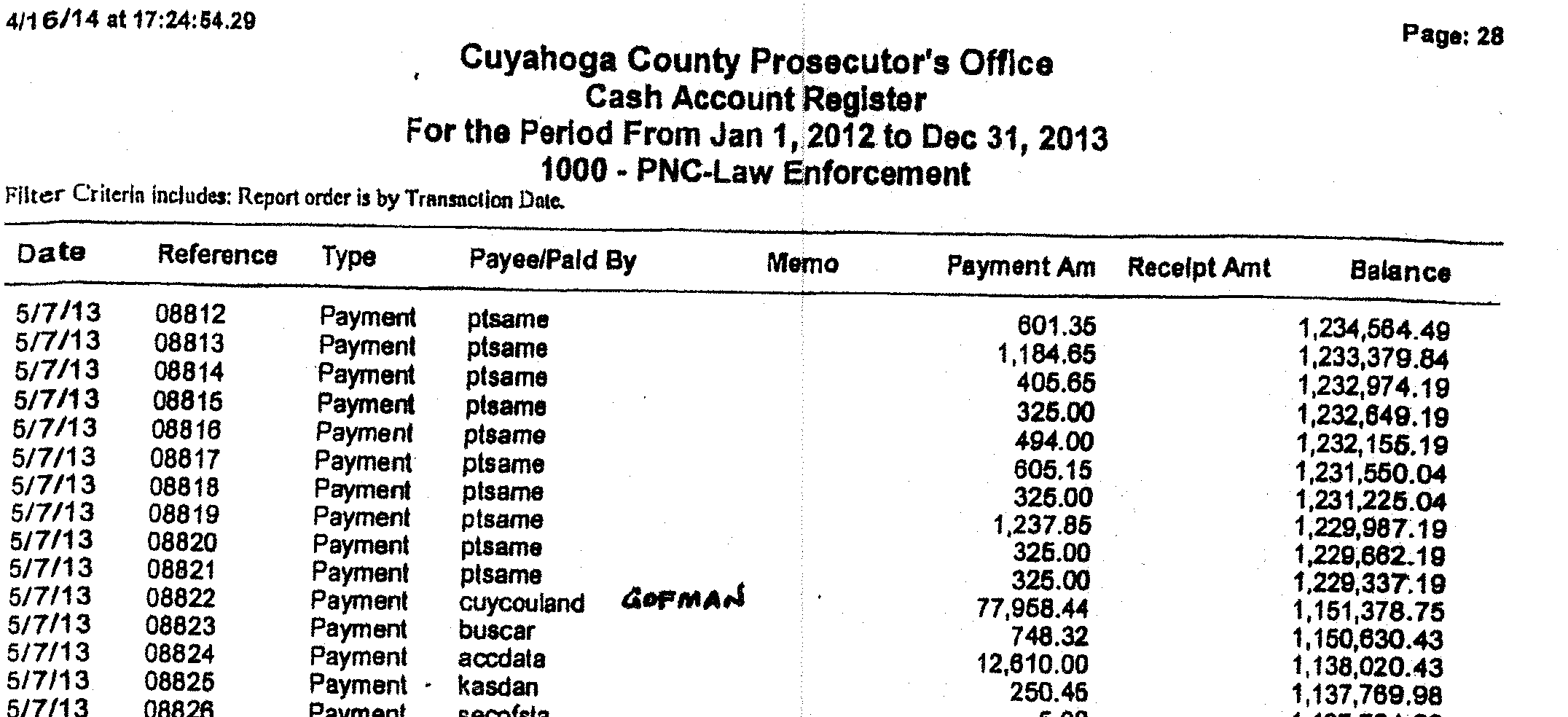
For over a decade, the government has collected restitution – sometimes as a condition of a defendant avoiding prison and frequently using aggressive tactics like seizing tax refunds, or other assets, but disbursement ledgers obtained by the FreeTonyViola.com Investigative team establish that prosecutors have used crime victim funds to pay for airline tickets, hotel rooms and purchasing computers for prosecutors and even payments to Senior Assistant Ohio Attorney General Dan Kasaris – but none of the funds have been paid to victims, who have separately stated in writing they have not received any payments.
All told, millions of dollars in restitution were deposited into government-controlled accounts and used for operational expenses rather than being disbursed to crime victims – making representations by prosecutors in applications and progress reports submitted to the Bureau of Justice Assistance materially false. Grants were awarded based upon representations that restitution was being collected and distributed to victims. Citing such progress, prosecutors even sought additional federal funding for mortgage fraud prosecutions.
The “Double Game” Problem: Banks as Victims and Wrongdoers
A further restitution issue is whether some institutional “victims” were truly victims at all, or whether their claimed losses were already resolved through civil settlements tied to their own misconduct. For example, the Department of Justice’s $13 billion JPMorgan settlement stated that JPMorgan acknowledged engaging in wrongdoing on transactions at issue in the Viola prosecution. The DOJ later reached similar mortgage-backed-securities settlements with Citigroup for $7 billion, Bank of America for $16.65 billion, Goldman Sachs for more than $5 billion, and Wells Fargo for $2.09 billion.
That creates a “double game” problem: in local mortgage fraud prosecutions, banks and lenders were treated as innocent victims entitled to restitution, while in other Department of Justice proceedings, those same institutions admitted wrongdoing – on the same transactions – and paid massive civil fraud penalties. Under In re WellCare Health Plans, Inc., 754 F.3d 1234, 1239 (11th Cir. 2014), a wrongdoer cannot simply repackage itself as a crime victim; the court held that “a perpetrator cannot be his own victim” and denied restitution where the entity seeking victim status had admitted participation in the fraud.
No Accounting for Multiple Recoveries
The law is clear: Victims are not allowed to receive more than any stated loss amount from restitution. Pursuant to 18 U.S.C. § 3664(j)(2), when a victim later recovers compensatory damages in a federal or state civil proceeding for the same loss, the restitution obligation must be reduced accordingly to prevent double recovery. The law is also clear that the government cannot collect more than permitted under court orders, and doing so constitutes an illegal seizure of assets. However, since the same transactions, mortgages and victims are involved in a myriad of cases, civil settlements and court orders, the government is required to track these multiple recoveries, but is failing to do so.
Consider this Single Property, 9013 Laisy, Cleveland, Ohio, which was included in multiple cases, with different theories of criminality
Deutsche Bank and its MortgageIT subsidiary were the alleged victims of mortgage fraud schemes, and are currently the beneficiaries of restitution concerning the property located at 9013 Laisy Avenue in USA v. Viola, 08-cr-506, N.D. Ohio (Count 20 in the indictment.) However, Deutsche Bank National Trust Company as Trustee for Long Beach Mortgage Loan Trust 2005-WL3 was the owner of the loan on Laisy Avenue and was the recipient of millions of dollars in civil fraud settlements concerning the same mortgage loan / transaction in Deutsche Bank v. FDIC, et. al., Case # 09-1656, DC District Court.
In addition, prosecutors pursued a different theory of criminality in Ohio v. Harris, case # 10-cr-551555, Cuyahoga County Common Pleas Court. There, the lender employees (and NOT parties to the transactions or Realtors like Viola) were responsible for any wrongdoing – including on Count 11, concerning the same property -- 9013 Laisy.
Prosecutors Mark Bennett and Dan Kasaris, and other members of the mortgage fraud task force, pursued mutually exclusive theories of criminality on the same transactions – banks are criminals or banks are innocent victims – and collected restitution and civil settlements without accounting for any of the funds received.
Prior Requests for an Investigation Ignored
Then-Presiding Judge John J. Russo acknowledged receiving concerns regarding restitution collection practices and referred the matter to the Cuyahoga County Public Defender's Office for review, but that office did nothing. Later, the Ohio Auditor of State acknowledged receipt of complaints concerning the Cuyahoga County Prosecutor's Office and referred the matter for further review by the appropriate oversight authorities, but nothing ever happened and, as of this date, no agency has ever investigated the matter. Even the Cuyahoga County Internal Auditor claims they are unable to audit the county prosecutor’s crime victim accounts.
“Federal and state, prosecutors imprisoned hundreds of Ohioans by claiming that they stole millions of dollars from lenders through so-called mortgage fraud schemes,” said Tony Viola. “However, these entities have stated that they are not victims, did not seek restitution and have not received restitution. Disbursement ledgers from the prosecutor’s office have established the misappropriation of over $20 million. It is long past time for an independent auditor to review the collection and disbursement of restitution by state and federal prosecutors and for unlawful restitution orders to be vacated.”
To view the court filing by Attorney Kim Corral, or supporting documentation about the misappropriation of crime victim funds, kindly visit the Evidence Locker of FreeTonyViola.com
About FreeTonyViola.com: FreeTonyViola.com is a justice-accountability platform dedicated to exposing prosecutorial misconduct and holding public officials responsible for actions that lead to wrongful convictions. FreeTonyViola.com exists for one reason: to expose prosecutorial misconduct and demand accountability when abuse of power results in wrongful convictions. Wrongful convictions are rarely the result of honest mistakes or momentary lapses in judgment. They are far more often caused by “win-at-all-costs” prosecution, refusal to acknowledge error, and the deliberate locking-in of narratives that prosecutors will not revisit—even when evidence contradicts their case. This platform documents those failures, preserves the evidence, and makes it public. Our focus is not rehabilitation services or re-entry assistance. Our focus is accountability — especially when prosecutors break the law, abuse their authority, or knowingly pursue convictions that cannot withstand scrutiny.
# # #